Life Settlements Blog
Infographic listing conditions that may qualify for a life settlement, along with other key eligibility factors such as age, policy type, and health status

If you or someone you love is experiencing a serious or chronic illness, you may be wondering whether your life insurance policy can be sold for cash. Conditions that may qualify for a life settlement vary widely, but they often include health issues that reduce life expectancy or cause a significant decline in health since the time the policy was issued. Even if a condition is not considered terminal, a life settlement may still be possible.

A life settlement is the sale of an existing life insurance policy to a third party buyer for a lump sum that is greater than the policy’s surrender value, but less than the death benefit. This option can provide financial relief for individuals who no longer need their coverage or who are struggling with healthcare and living expenses due to illness.

Common Conditions That May Qualify

Some of the more commonly accepted qualifying conditions for a life settlement include:

  • Advanced Cancer (including recurrence or metastasis)
  • Congestive Heart Failure (CHF)
  • Chronic Obstructive Pulmonary Disease (COPD)
  • Stroke with lasting effects
  • Chronic Kidney Disease or Dialysis
  • Parkinson’s Disease
  • Alzheimer’s Disease or Dementia
  • ALS (Lou Gehrig’s Disease)
  • Severe Diabetes with complications
  • Liver Disease or Cirrhosis

In many cases, the key eligibility factor is not the specific diagnosis but the slippage in health that has occurred since the policy was issued. If your health has declined significantly, even if the condition is managed, you may still be eligible.

Lesser-Known or Rare Conditions

While less common, the following conditions may also qualify, particularly when they limit life expectancy or cause functional decline:

Each of these conditions may qualify depending on the specifics of the case. Factors such as the stage of the illness, rate of progression, and overall health history all play a role in determining eligibility. Even when a condition is less common, it may still meet the criteria for a life settlement based on life expectancy and policy details.

Other Factors That Affect Eligibility

In addition to the diagnosis itself, several other factors impact life settlement eligibility:

  • Policy Type – Most universal life and convertible term policies qualify
  • Policy Size – Typically, policies with a $100,000 face value or more are eligible
  • Health Changes – Decline in health since the time of policy issuance
  • Age – Generally 65 or older, though younger individuals with serious health conditions may qualify

A Path to Financial Relief

If you’re unsure whether your condition qualifies, it’s worth exploring your options. Many people are surprised to learn that their policy still has value, even if it has no cash value or is close to lapsing. A life settlement may offer a practical way to reduce financial strain, fund care needs, or improve quality of life during a challenging time.

To learn if you qualify, please give us a call at 800-727-7654.  In a short, 5-10 minute phone call, you can find out if your policy may have a hidden value. 
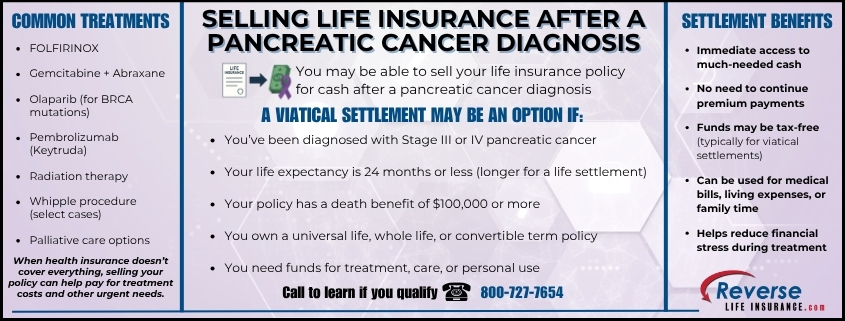
Infographic showing how selling life insurance after a pancreatic cancer diagnosis may provide financial relief through a viatical settlement

If you’re exploring your financial options after a serious diagnosis, selling life insurance after a pancreatic cancer diagnosis may be one of the most impactful decisions you can make. Most individuals with advanced pancreatic cancer will qualify for a viatical settlement, not just a traditional life settlement. This means they may be eligible to sell their policy for a lump sum payment, even if it has no cash value, based on their current health status.

A viatical settlement is a specialized type of life settlement designed for individuals with a serious illness, typically with a life expectancy of less than two years. Because pancreatic cancer is often diagnosed in later stages, many patients meet this threshold and can access substantial funds through the sale of their life insurance policy.

What Is a Viatical Settlement?

A viatical settlement allows someone with a qualifying medical condition to sell their life insurance policy to a viatical settlement buyer for immediate cash. The buyer takes over future premium payments and receives the death benefit when the insured passes away. The payout from a viatical settlement is usually tax free and it can be used for anything from medical treatment to paying off debt or creating lasting memories with loved ones.  Always consult with your trusted tax advisor regarding your specific situation.

While some individuals with earlier-stage or successfully treated pancreatic cancer may qualify for a traditional life settlement, the majority will qualify under viatical settlement guidelines due to the severity and prognosis associated with this type of cancer. Viatical settlements are essentially life settlements for terminal illness.

Who Qualifies?

Eligibility depends on a combination of medical and policy factors:

  • Diagnosis of pancreatic cancer, particularly Stage III or Stage IV
  • Inoperable, metastatic, or recurrent disease
  • A life expectancy of 24 months or less (longer for a life settlement)
  • A life insurance policy with a face amount typically over $100,000
  • Policy type: universal life, whole life, or convertible term policies are generally eligible.  Other types may also qualify.  It is always best to ask.

Many people who don’t have cash value in their policy mistakenly assume they don’t qualify, but even term policies can be sold if they include a conversion option.

Common Treatments for Pancreatic Cancer

The type and stage of pancreatic cancer, along with overall health, influence treatment decisions. Common treatments include:

  • Chemotherapy
    Often used as a first-line treatment, with drugs such as FOLFIRINOX, gemcitabine, and nab-paclitaxel (Abraxane)
  • Targeted Therapy
    Some patients may receive PARP inhibitors like olaparib if they carry certain genetic mutations (such as BRCA1/2)
  • Immunotherapy
    For patients with specific biomarkers (such as microsatellite instability-high tumors), immune checkpoint inhibitors such as pembrolizumab (Keytruda) may be used
  • Radiation Therapy
    Sometimes used for locally advanced tumors to relieve symptoms or shrink the tumor before surgery
  • Surgery
    In select cases, surgery such as the Whipple procedure (pancreaticoduodenectomy) may be an option, although only a small percentage of patients are surgical candidates at diagnosis
  • Palliative Care
    Focuses on symptom relief and quality of life, and may be provided alongside curative or life-extending treatments

Because treatment costs can escalate quickly and many times, health insurance does not cover all expenses, selling a life insurance policy may provide a critical source of funding when other resources are limited.

Why Consider a Viatical or Life Settlement?

Many individuals are unaware that they can sell their policy for immediate cash. This can be especially important when:

  • Treatment is expensive and not fully covered by insurance
  • You’re unable to work or earn income
  • Your family needs financial support
  • You want to reduce end-of-life stress or travel to be with loved ones
  • You’re planning for palliative care, hospice, or in-home support

A viatical settlement may allow you to redirect your policy’s value toward living needs, now when you need it the most.

Selling life insurance after a pancreatic cancer diagnosis can provide much-needed financial relief, especially if you qualify for a viatical settlement. Most people with late-stage or inoperable pancreatic cancer do. If your life expectancy is limited due to this diagnosis, you may be eligible to receive a lump-sum payment from your policy without taking out loans, incurring debt, or waiting for a death benefit to be paid to beneficiaries.

If you or a loved one is navigating a pancreatic cancer diagnosis, exploring a viatical or life settlement can help provide immediate support, flexibility, and peace of mind during an incredibly difficult time.  Please give us a call today at 800-727-7654 to learn if you qualify.

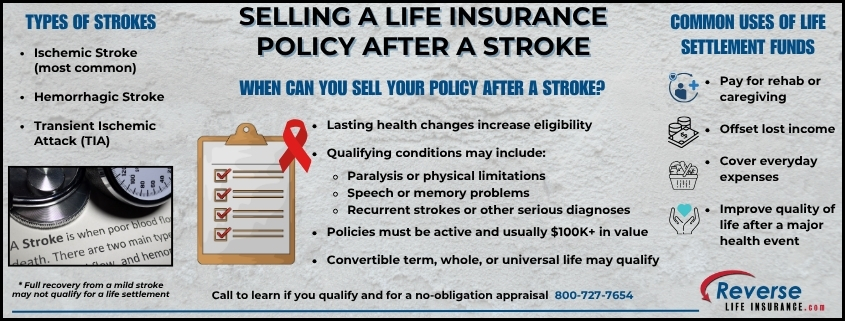
Infographic showing eligibility and benefits of selling a life insurance policy after a stroke, including stroke types, qualifying health changes, and common uses for settlement funds

Experiencing a stroke can dramatically shift a person’s financial and medical outlook. For seniors or their families, selling a life insurance policy after a stroke may offer a way to relieve financial pressure, particularly when long-term care, rehabilitation, or loss of income becomes a concern. While not everyone who’s had a stroke will qualify, a life settlement can be a powerful tool for those whose health has been seriously affected.

What Is a Life Settlement?

A life settlement allows a policyholder to sell their life insurance policy to a third-party buyer for a lump sum cash payment. The buyer takes over premium payments and receives the death benefit when the insured passes away. Life settlements are typically available to individuals over age 65, but younger people may qualify if they have serious health conditions such as the aftereffects of a stroke.

When a Stroke May Qualify Someone for a Life Settlement

A stroke, or cerebrovascular accident (CVA), can vary significantly in severity. A policy may be eligible for a life settlement if the insured has ongoing complications such as:

  • Partial paralysis or weakness (hemiparesis)
  • Difficulty speaking or swallowing
  • Cognitive decline or memory problems
  • Dependence on a caregiver for daily tasks
  • Recurrent strokes or other comorbid conditions (such as heart disease or diabetes)

These long-term effects signal a substantial change in health from when the policy was originally issued, which is a key factor in determining eligibility. Those with a severely shortened life expectancy may be eligible for a viatical settlement.

When a Stroke May Not Qualify

It’s important to understand that not all strokes result in long-term health deterioration. If the stroke was mild (a transient ischemic attack or mini-stroke) and the individual made a full recovery with no lasting impairment, selling a life insurance policy after a stroke may not be an option. Life settlement buyers typically require evidence of a serious decline in health or a shortened life expectancy when considering a policy for purchase.

Types of Policies That May Be Eligible

The following types of policies are generally considered:

  • Universal Life
  • Whole Life
  • Convertible Term Life (must still be within the conversion window)

Policies should generally have a face value of at least $100,000. The premium costs and remaining coverage length will also factor into a policy’s life settlement value.  If your policy type is not listed, please give us a call.  Every case is unique and it is always best to ask. 

Using Funds from a Life Settlement

Proceeds from a life settlement can be used for:

  • Home health care or assisted living
  • Rehabilitation therapy or equipment
  • Paying off debt or medical bills
  • Covering everyday expenses during recovery

There are no restrictions on how funds are used.  This financial flexibility can make a major difference during a time of uncertainty.

Selling a life insurance policy after a stroke is worth exploring for individuals whose stroke has led to lasting health challenges. It’s not always a guaranteed option, especially if the stroke caused no permanent damage, but for many, it may offer a source of much needed financial support.

To learn if you’re  likely to qualify, please give us a call today at 800-727-7654.  It usually only takes a 5-10 minute phone call to learn if you’re eligible to access the hidden value in your life insurance policy through a life settlement. 

Infographic explaining life settlements for advanced diabetes, highlighting qualifying complications and common uses for settlement funds

Many people are surprised to learn that it’s possible to access funds from a life insurance policy while still alive. For those living with serious health conditions, selling a policy through a life settlement may provide much needed financial relief. Life settlements for advanced diabetes can help when complications from this progressive disease shorten life expectancy and increase the need for expensive care whether it be for treatments or for specialized home care.

Understanding the Life Settlement Process

A life settlement allows the policyholder to sell their existing life insurance policy to a third-party buyer in exchange for a lump sum that is greater than the policy’s cash surrender value but less than the full death benefit. The buyer then assumes responsibility for future premiums and becomes the new owner and beneficiary of the policy.

To qualify, most sellers must be age 65 or older and have a health condition that significantly impacts life expectancy. This is where the severity and management of diabetes come into play. Those that qualify may be able to turn life insurance into cash to help cover treatment costs.

When Diabetes May Qualify for a Life Settlement

Not everyone with diabetes will qualify. Well-managed diabetes, especially when controlled with oral medication and stable lab results, often does not reduce life expectancy enough to meet settlement eligibility criteria.

However, advanced diabetes, especially when accompanied by serious complications, may qualify. Common complications include:

  • Chronic kidney disease or dialysis
  • Severe neuropathy
  • Amputations
  • Diabetic retinopathy
  • Frequent hospitalizations or infections
  • Uncontrolled blood sugar levels over time
  • Cardiovascular complications

In these cases, the policyholder’s health may be evaluated as high risk, and a life settlement buyer may offer a substantial lump sum payout. Many policies can qualify including universal life, whole life, and even convertible term policies which may qualify for a term life insurance settlement

Using Settlement Funds for Medical Costs

Managing advanced diabetes often means facing high out-of-pocket expenses for:

  • Frequent doctor and specialist visits
  • Medications and insulin
  • Wound care or prosthetics
  • Home health aides or assisted living

A life settlement can help cover these costs, providing financial flexibility and reducing the burden on family members. In some cases, the funds are also used to pay off debt or create a financial cushion during retirement.  There are no restrictions on the use of funds.

Next Steps for Policyholders with Diabetes

If you or a loved one is living with advanced diabetes and owns a life insurance policy, a life settlement could be worth exploring. The process typically begins with a policy review and health assessment to determine eligibility. Even if you’re unsure whether your diabetes is advanced enough, it may still be worth checking with an experienced life settlement company.

Life settlements for advanced diabetes can offer a financial lifeline when the cost of care becomes overwhelming. While not all people with diabetes will qualify, those with serious complications may be able to turn an underused policy into immediate financial support. To learn if you qualify in a short 5-10 minute phone call, please give us a call at 800-727-7654.  We can help you obtain a no obligation policy appraisal to help you get an idea of the hidden value in your life insurance.

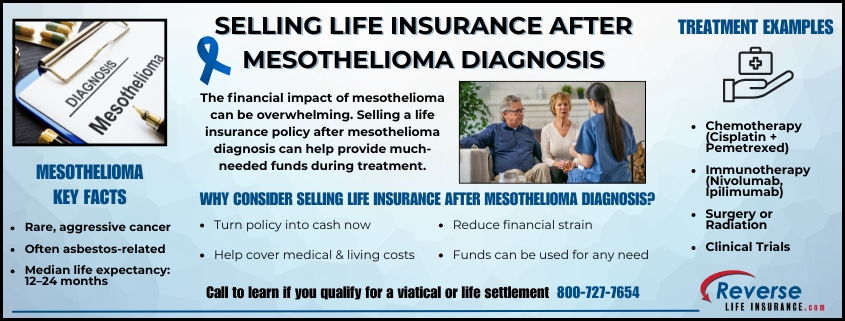
Infographic explaining how selling life insurance after mesothelioma diagnosis can help cover medical bills, care expenses, and financial needs.

Following a mesothelioma diagnosis, many patients and their families are confronted with not only complex treatment decisions but also the financial burden that often comes with serious illness. Selling life insurance after mesothelioma diagnosis can offer a practical solution by turning an existing policy into immediate funds to help manage medical costs, household expenses, or other financial priorities during this difficult time.

Understanding Mesothelioma and Life Expectancy

Mesothelioma is a rare and aggressive cancer, most commonly caused by exposure to asbestos. It primarily affects the lining of the lungs (pleural mesothelioma) but can also develop in the lining of the abdomen (peritoneal mesothelioma) or other areas. Because mesothelioma is often diagnosed in later stages, it carries a limited life expectancy. Many patients face survival periods of 12 to 24 months after diagnosis, though some may live longer depending on the type of mesothelioma, age, overall health, and available treatment options.

The serious nature of this illness is one reason why selling life insurance after mesothelioma diagnosis may be an option for many policyholders. Life settlement providers often consider the reduced life expectancy when evaluating a policy, which can result in higher offers compared to individuals with chronic but less severe conditions.

Who May Qualify to Sell Life Insurance After Mesothelioma Diagnosis

Eligibility for selling a life insurance policy after mesothelioma diagnosis depends on several factors, including:

  • The stage and type of mesothelioma
  • The insured’s age and overall health
  • Life expectancy projections based on medical records
  • The face amount of the policy
  • The type of policy (universal, whole life, or convertible term)

Because mesothelioma is classified as a terminal or life-limiting condition in most cases, many individuals meet the qualifying criteria for a life settlement or viatical settlement.

Common Treatments for Mesothelioma

While there is no cure for mesothelioma, advances in treatment have provided options to help slow progression and manage symptoms. Some of the common therapies include:

  • Chemotherapy (such as cisplatin and pemetrexed)
  • Immunotherapy (including nivolumab and ipilimumab)
  • Surgery (pleurectomy/decortication or extrapleural pneumonectomy)
  • Radiation therapy
  • Clinical trials offering experimental treatments

Even with treatment, many patients experience significant financial strain from medical costs, travel for specialized care, loss of income, and ongoing living expenses.

How Selling Life Insurance After Mesothelioma Diagnosis Can Help

Selling a life insurance policy allows the policyholder to receive a lump sum cash payment that can be used immediately. Common uses for the funds include:

  • Paying for ongoing medical treatments
  • Covering in-home care or hospice expenses
  • Managing household bills and debts
  • Providing financial stability for loved ones
  • Funding travel, personal goals, or creating lasting memories

Unlike loans or borrowing against a policy, a life settlement provides funds without the obligation to repay, offering much-needed relief during a challenging time.

Next Steps

If you or a loved one is exploring options for selling life insurance after mesothelioma diagnosis, it’s important to work with experienced professionals who understand both the life settlement process and the sensitive nature of this illness. An evaluation can help determine eligibility and provide a clear understanding of the potential value your policy may offer.  Learn if you qualify in a short 5-10 minute phone call.  800-727-7654

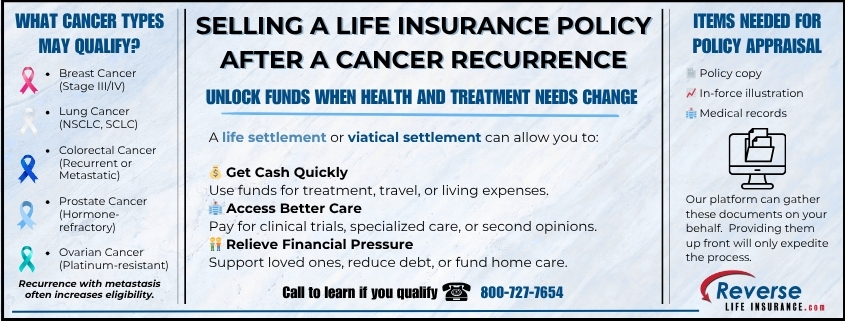
Infographic explaining how selling a life insurance policy after a cancer recurrence can help cover medical treatments, caregiving costs, and living expenses, with key eligibility criteria and required documents.

If you’re dealing with a second cancer diagnosis, you’re likely facing not only a new wave of medical decisions but also mounting financial concerns. Selling a life insurance policy after a cancer recurrence is one option that many people are unaware of, but it can offer substantial relief during a difficult time. A life settlement allows you to access the hidden value in your life insurance policy and receive a cash payout, which can be used for treatment, caregiving expenses, or simply to maintain your quality of life.

Unlike a policy loan or surrender, a life settlement can result in a significantly higher payout, especially for individuals whose health has changed. A recurrence of cancer often signals a more serious prognosis, which is a major consideration for life settlement purchasers.

Why a Cancer Recurrence May Qualify You

Many policyholders are surprised to learn that they didn’t qualify for a life settlement during their initial cancer treatment, but may now be eligible after a recurrence. Life expectancy is one of the primary factors evaluated in the settlement process. If your cancer has returned, spread to new areas, or stopped responding to standard treatments, your eligibility for a life settlement may have increased.

Life settlement providers typically consider:

  • The type and stage of cancer at recurrence
  • Whether the cancer is localized or metastatic
  • Current and past treatment history
  • Your age and overall health status
  • The size, type, and premiums of your policy

Cancers Commonly Considered for Life Settlements After Recurrence

While nearly any cancer type may qualify in advanced stages, some are particularly likely to be eligible when recurrence is involved:

Breast Cancer

Those facing recurrent estrogen receptor-positive breast cancer, especially with spread to the bones, liver, or brain, may be undergoing advanced treatment regimens such as Ibrance (palbociclib), Kisqali (ribociclib), or capecitabine. These patients often meet life settlement criteria due to reduced long-term survival rates.

Lung Cancer

Recurrent non-small cell lung cancer (NSCLC) or small cell lung cancer (SCLC) with limited treatment response or progression despite targeted therapy (e.g., Tagrisso, Alecensa) or immunotherapy (e.g., Keytruda, Opdivo) is typically eligible, particularly in cases with metastasis to the brain or adrenal glands.

Colorectal Cancer

If colorectal cancer returns after surgery or chemotherapy, especially with metastasis to the liver or peritoneum, and treatment includes drugs like Avastin, Lonsurf, or second-line chemotherapy, eligibility for a life settlement is likely.

Prostate Cancer

Men with recurrent or metastatic prostate cancer that has progressed despite hormone therapy (often requiring Xtandi, Zytiga, or chemotherapy) may meet the medical criteria for a life settlement, particularly when bone metastases are present.

Ovarian Cancer

Patients with platinum-resistant ovarian cancer undergoing treatment with Doxil, Lynparza, or bevacizumab are often facing a challenging prognosis and may benefit from unlocking the value of a life insurance policy.

What You’ll Need to Get Started

The process begins with an evaluation. You’ll need to provide:

  • A copy of your life insurance policy
  • An in-force illustration (provided by your insurance company)
  • Recent medical records showing your diagnosis and current condition
  • A list of current medications and treatment plans

These details help providers assess your eligibility and determine a fair market value for your policy.

How the Funds Can Be Used

There are no restrictions on how you use the proceeds from a life settlement. Many individuals use the funds for:

  • Specialized or out-of-network cancer treatments
  • Clinical trial expenses
  • In-home caregiving or hospice services
  • Travel to top cancer centers
  • Everyday living expenses
  • Reducing debt or supporting loved ones

A cancer recurrence is difficult enough without the added weight of financial uncertainty. A life settlement can give you back some control and allow you to focus on what matters most.

Selling a life insurance policy after a cancer recurrence is a path worth considering for those who need access to cash during a time of escalating medical costs and personal stress. If you or someone you care for is facing a second cancer diagnosis, it’s worth exploring whether your policy can offer more than peace of mind. It could provide meaningful financial relief when it’s needed most.

To learn if you qualify and for a no-obligation policy appraisal, please give us a call today.  800-727-7654

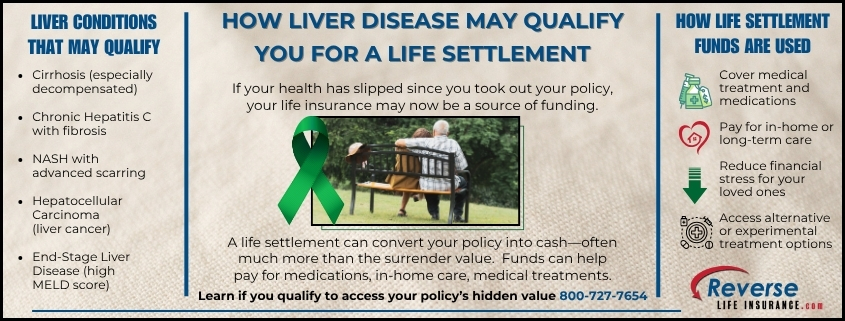
Infographic explaining how liver disease may qualify you for a life settlement, including eligible conditions, treatment costs, and ways funds can be used

For many seniors facing progressive health issues, a life insurance policy can be more than just a safety net for beneficiaries – it can become a valuable financial resource. If you’re living with a serious liver condition, knowing how liver disease may qualify you for a life settlement could open the door to much-needed financial relief. In many cases, individuals with moderate to advanced liver disease may be eligible to sell their life insurance policy for a lump sum, providing funds for treatment, caregiving, or other pressing expenses.

Understanding Life Settlements and Liver Disease

A life settlement involves selling an existing life insurance policy to a buyer in exchange for a cash payment that is more than the policy’s surrender value, but less than the full death benefit. This option is most commonly available to individuals over age 65 or those with significant health conditions that reduce life expectancy. Liver disease, especially when it progresses or becomes life-limiting, can often qualify.

Types and Stages of Liver Disease That May Qualify

Several types and stages of liver disease may impact life expectancy enough to qualify for a life settlement:

  • Cirrhosis – Particularly decompensated cirrhosis, which significantly impairs liver function and often leads to hospitalization or complications.
  • Chronic Hepatitis C – Especially if it has progressed to cause fibrosis or cirrhosis.
  • Nonalcoholic Steatohepatitis (NASH) – Advanced cases with liver scarring (fibrosis or cirrhosis) may qualify.
  • Liver Cancer (Hepatocellular Carcinoma) – Often qualifies when not treatable by surgery or transplant.
  • End-Stage Liver Disease (ESLD) – Patients with high MELD scores may be eligible for higher life settlement offers or for a viatical settlement.

Common Treatments and Financial Challenges

Managing liver disease often involves expensive treatments and long-term care. Depending on the stage and complications, patients may require:

  • Antiviral medications for hepatitis
  • Immunosuppressive drugs for autoimmune liver conditions
  • Lactulose or rifaximin to manage encephalopathy
  • Frequent procedures like paracentesis for fluid buildup
  • Cancer treatments, including immunotherapy, ablation, or targeted drugs

Even with insurance, out-of-pocket costs for medications, transportation, caregivers, or assisted living can be overwhelming.

Why Consider a Life Settlement?

A life settlement provides immediate access to cash that can be used to:

  • Pay for medical treatment and caregiving
  • Offset in-home care or assisted living expenses
  • Eliminate debt or relieve financial stress for loved ones
  • Explore alternative or advanced treatments not covered by insurance
  • Travel or just enjoy time with loved ones

For those dealing with liver disease, a life settlement can offer both financial and emotional relief at a difficult time.

If your health has slipped since taking out your life insurance policy, you may be reassessing your financial options. Learning how liver disease may qualify you for a life settlement could help you unlock the value of your policy when you need it most.  Your policy may hold a hidden value that can be converted into immediate funds to support your care and expenses.

To find out if you qualify, please give us a call at 800-727-7654 for a no-obligation policy review and appraisal.

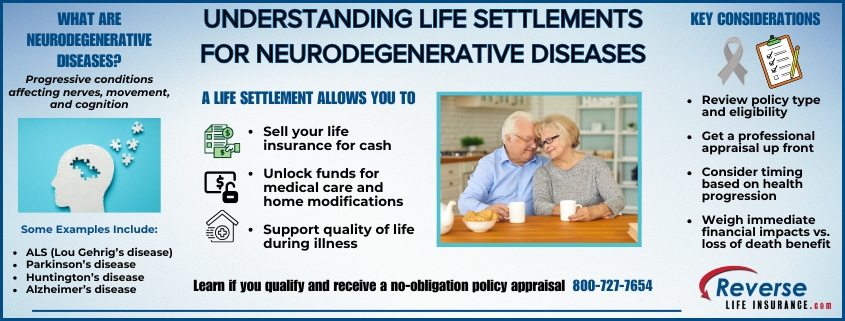
Infographic illustrating the key concepts of understanding life settlements for neurodegenerative diseases, including how policyholders can sell their life insurance to access funds for care and support during illness

Understanding life settlements for neurodegenerative diseases is crucial for patients and families facing the emotional and financial burden of these progressive conditions. Neurodegenerative diseases such as Amyotrophic Lateral Sclerosis (ALS), Parkinson’s disease, Huntington’s disease, Alzheimer’s disease, and multiple system atrophy are marked by the gradual loss of nerve cell function, leading to cognitive and physical decline over time. These diseases often require long-term care, specialized medical equipment, and assistance with daily living, creating financial stress for families.

A life settlement offers a potential solution. It involves selling an existing life insurance policy to a third-party buyer for a lump-sum payment that is higher than the policy’s cash surrender value but less than the death benefit. Life settlements can provide immediate funds to cover mounting medical and care-related expenses, helping ease the financial strain.

How Neurodegenerative Diseases Affect Life Settlement Eligibility

Life settlements are generally available to individuals who meet certain criteria:

  • Age 65 or older, or younger with a significant qualifying health condition.
  • A life insurance policy with a face value of $100,000 or more.
  • A life expectancy typically between 2 to 10 years, which can result from a progressive disease like ALS or Huntingtons disease.  Shorter life expectancies can qualify for a viatical settlement which also provides a lump sum cash payment but is designed for terminally ill patients.

Neurodegenerative diseases often lead to functional decline, including loss of mobility, cognitive impairment, and progressive health deterioration. As the disease advances and life expectancy shortens, individuals may become eligible for higher life settlement offers.

For example:

  • ALS (Lou Gehrig’s disease) has an average life expectancy of 2 to 5 years post-diagnosis, often qualifying patients for significant offers.
  • Huntington’s disease, with a gradual progression but inevitable decline, may lead to eligibility in the mid to later stages.
  • Advanced Parkinsons disease can reduce life expectancy, particularly with complications like pneumonia or falls.

Case Study: ALS Patient Funding Home Care

Consider the case of John, a 58-year-old diagnosed with ALS. As his mobility declined, his wife could no longer care for him alone. John owned a $250,000 universal life insurance policy. After consulting a life settlement company, he sold the policy for $85,000. These funds were used to modify their home for wheelchair access and hire professional caregivers, dramatically improving his quality of life during his remaining years.

Key Considerations for Patients and Families

When considering a life settlement, patients with neurodegenerative diseases should:

  • Review the policy type: Term policies nearing expiration may still be eligible, especially if convertible; permanent policies (whole or universal life) are often more valuable.
  • Get a professional appraisal: An experienced life settlement company can assist you with learning the market value of a policy and estimate potential settlement offers.
  • Understand the timing: Early-stage neurodegenerative diseases may not qualify, but advancing symptoms and medical documentation can support eligibility.
  • Weigh financial implications: Selling a policy provides immediate funds but forfeits the death benefit for beneficiaries as the new owner takes over ownership and beneficiary rights to the policy.

Using Life Settlement Funds for Neurodegenerative Diseases

The proceeds from a life settlement can be used for:

  • In-home or residential care: Covering the cost of caregivers, nurses, and assisted living.
  • Medical treatments and equipment: Funding medications, therapies, mobility aids, and specialized technology.
  • Home modifications: Installing ramps, lifts, and accessible bathroom facilities.
  • Caregiver support: Providing financial stability for family members assisting with care.
  • Quality of life improvements: Enabling travel, counseling, or other supportive services.

Understanding life settlements for neurodegenerative diseases empowers patients and families to make informed financial decisions during a difficult time. By unlocking the hidden value of a life insurance policy, a life settlement can provide essential funds to support care, improve quality of life, and ease financial burdens. As neurodegenerative diseases progress, exploring a life settlement may offer a critical financial lifeline when it’s needed most.

To learn if you qualify and obtain a no-obligation policy appraisal, please give us a call today at 800-727-7654.

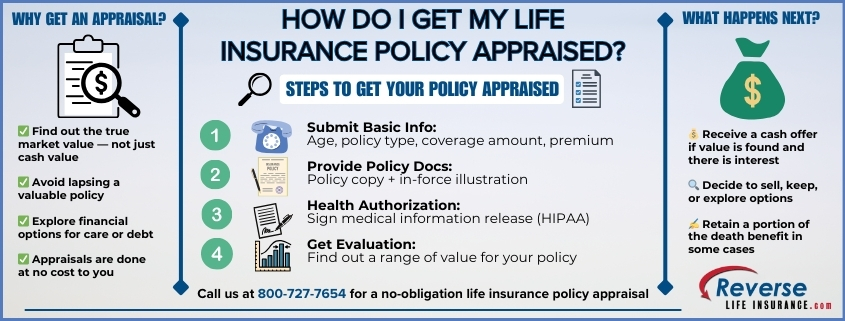
Infographic titled “How Do I Get My Life Insurance Policy Appraised” showing reasons to get an appraisal, steps in the process, and what happens next

If you’re asking yourself How do I get my life insurance policy appraised?, you’re starting at the right point. Never sell your life insurance policy without first getting it appraised yourself.   Many policyholders reach a point where they want to understand the true value of their life insurance – not just the surrender value, but what it could actually be worth in the secondary market. Whether you’re facing rising premium costs, unexpected medical expenses, or simply reevaluating your financial plans, a life insurance appraisal can help you make an informed decision.

What Is a Life Insurance Policy Appraisal?

A life insurance appraisal estimates what your policy could sell for in a life settlement, a legal, regulated transaction where you sell your life insurance to a third-party buyer for a lump sum cash payment. Unlike cash value or surrender value, an appraisal reflects the fair market value, which can be significantly higher depending on your situation.

When Should You Consider an Appraisal?

There are several situations where an appraisal makes sense:

  • Your policy premiums are becoming unaffordable
  • You no longer need the coverage (e.g., your children are financially independent)
  • You’re planning for retirement, long-term care, or assisted living
  • You’re considering lapsing or surrendering your policy and want to explore alternatives

Even policies with no cash value, such as term life insurance, may be eligible — especially if you’re over age 65 or have a serious health condition.

What Factors Affect Your Policy’s Value?

Buyers consider several key factors when appraising a policy:

  • Your age and health status: Older age or certain medical conditions can increase value
  • Policy type: Universal and whole life are most commonly sold, but convertible term policies can qualify too
  • Death benefit amount: Typically, policies valued at $100,000 or more are considered.  Some lower face amount policies may qualify if someone has a serious medical condition.
  • Premium costs: Lower premiums relative to the policy face value make policies more attractive to buyers
  • Insurance carrier rating: Highly rated carriers are preferred by investors

How to Get a Life Insurance Policy Appraised

Getting an appraisal is simpler than you might think. Here’s how it works:

  1. Submit basic information – This usually includes your age, policy type, face amount, and premium costs.
  2. Provide policy documents – A copy of the policy and an in-force illustration are often requested.
  3. Share health details – You will need to authorize release of medical records and in some cases complete a health questionnaire.  No new medical exams are required.
  4. Wait for evaluation – Policy and health information will be reviewed in order to give you an idea of a potential range of value.  If value is found and there is interest, a direct offer will be presented to you.

You’re under no obligation to sell just for requesting an appraisal. 

What Happens After the Appraisal?

If your policy qualifies and there is interest from a buyer, you’ll receive a no-obligation offer. From there, you can decide whether to move forward, keep the policy, or explore other financial options. In some cases, you may even be able to retain a portion of the benefit while still receiving a cash payout.

Knowing how do I get my life insurance policy appraised gives you more control over your financial future. Rather than letting a policy lapse or accepting a low surrender value, you may be able to convert it into a lump sum of cash  with no repayment required. If you’re unsure whether your policy qualifies, an appraisal is the first step toward unlocking its hidden value.

Learn if you qualify in a 5-10 minute phone call.  800-727-7654

Infographic titled "Do You Have to Be Sick to Sell Your Life Insurance Policy" with eligibility info and settlement type comparison.

If you’re exploring your financial options and wondering, do you have to be sick to sell your life insurance policy, the answer is no—but your health does play a role in how much your policy might be worth. While terminal illness is a factor in some types of life insurance sales, it’s not required to qualify for what’s known as a life settlement. In fact, many people in average health or even relatively good health can still sell their policy for cash under the right circumstances.

Understanding the Difference: Life Settlement vs. Viatical Settlement

The idea that you must be seriously ill to sell your policy often comes from confusion between two distinct financial transactions:

  • A viatical settlement involves selling a life insurance policy when the insured has a terminal illness, typically with a life expectancy of two years or less.
  • A life settlement, on the other hand, is for people who are not terminally ill but meet certain age and policy requirements—most commonly, age 65 or older with a policy valued at $100,000 or more.

Both options allow you to receive a lump-sum payment by selling your policy to a licensed buyer, but only viatical settlements require a qualifying illness.

You Don’t Need to Be Sick—But Health Affects Value

You can absolutely qualify to sell your life insurance policy without being sick. However, your age and overall health do impact how much a buyer is willing to pay. That’s because the buyer assumes responsibility for paying future premiums and ultimately collects the death benefit when the insured passes away.

If you are in excellent health and expected to live many more years, the buyer will likely need to pay premiums for a long time, reducing the immediate value of the policy to them. On the other hand, if you have chronic conditions or a shorter life expectancy, the investor might make a higher offer because their return is expected sooner.

Still, many people in average health receive substantial offers.  While lower premiums typically result in stronger offers since buyers take on the cost of future premium payments, policyholders don’t need to be terminally ill to qualify. If you’re considering surrendering your policy or letting it lapse, it’s worth checking to see what a buyer might offer instead.

Who Is a Good Candidate for a Life Settlement?

Even without a serious illness, you may be eligible to sell your life insurance policy if:

  • You’re over the age of 65
  • You own a convertible term, universal, or whole life policy with a death benefit of at least $100,000
  • Your premiums have become too expensive
  • Your beneficiaries no longer rely on the death benefit
  • You no longer need the coverage due to life changes, estate planning, or retirement

Many seniors consider a life settlement when they’re thinking about letting a policy lapse or surrendering it to the insurer for a small cash value. In those cases, a life settlement can provide a significantly larger return and allow you to turn life insurance into cash.

What Buyers Look For

Buyers in the life settlement market evaluate several factors when deciding how much to offer, including:

  • Your age and health profile
  • Type of policy
  • Premium cost and payment history
  • Face value or death benefit of the policy
  • Whether the policy is in-force and has been active long enough to pass the contestability period

They use actuarial data and life expectancy estimates to determine how long they may be paying premiums before receiving a return on their investment.

Why People Sell Their Policies

People sell life insurance policies for many reasons. Some need cash for medical bills, debt repayment, or long-term care. Others want to supplement retirement income, fund a move to assisted living, or simply reduce monthly expenses. Selling a policy can free up cash that would otherwise go unused, especially if the policy was destined to lapse or be surrendered for little value.

So, do you have to be sick to sell your life insurance policy? No, you don’t. While health status affects the size of the offer, it’s not a barrier to qualifying. If you’re over 65 and have a qualifying policy, you may be eligible for a life settlement—no terminal diagnosis required. Before cancelling or surrendering your policy, it’s worth seeing what it could be worth on the secondary market.  Call us today to learn if you qualify.  800-727-7654

Do You Qualify?